
Finding Town of Newburgh Residents
No public source lists every Town of Newburgh household. The best entry point depends on what you know. For owner-of-record questions, start with the county property tools. The state voter-status lookup can corroborate one narrowly identified person. Recorded deeds, old directory volumes, court indexes, and archive collections each answer a different question. Any of them can point to a name, an address, or a parcel without proving that someone lives there now.
Lead with your most stable detail. A parcel number beats an old mailing line. A full name paired with a municipality, a middle initial, a relative, or a past address is far safer than a name alone. The Town of Newburgh spans rural, suburban, and urban-edge territory, so keep the municipality, the source date, and the record type together in your notes. Those details turn a stray match into usable directory evidence.
- Search the county parcel route by owner, address, tax-map number, or municipality and preserve the parcel reference.
- Check the county GIS viewer for the municipal boundary, road, and parcel geometry.
- Use the New York voter lookup only for an identified status question with its required inputs.
- Follow an ownership question to County Clerk land records, then use library and archive material for earlier household clues.
- Ask the proper office for existing non-exempt records when a web route ends.
Town of Newburgh Boundary Check
Place names trip people up here. The Village of Newburgh split off in 1800. The City of Newburgh was incorporated in 1865. Both the remaining town and the city can share a Newburgh mailing address, especially inside ZIP Code 12550. A city line in a directory, an obituary, or a mailing label settles nothing about jurisdiction. Before treating an address as Town of Newburgh evidence, check the county parcel municipality and the GIS boundary layer. Also check the deed description and a dated map. The parcel record, not the postal line, settles it.
Old records need the same care. Historical directories often reflect the city rather than the town. A given volume may cover a regional service area or an address whose jurisdiction later shifted. ZIP Codes postdate much of that directory run anyway. A dated street, legal description, tax map, atlas, or census geography builds the strongest bridge from an old Newburgh reference to a current Town parcel. Skip it, and the past residents trail goes cold.
Town of Newburgh Parcel Trail
Start with the county's parcel hub. Orange County Parcel Information offers free searches around the clock by owner name, address, tax-map number, and municipality. Its advertised output includes owner and parcel details, assessed values, tax maps, photographs, comparable searches, and a report writer. It traces property and owner of record. Live result fields and the report writer appear in the portal itself. A parcel record is not a household census.
The Orange County GIS Parcel Viewer adds the map. Official help documents searches by owner name, street address, and parcel ID, with partial strings accepted and scopes for all municipalities, a single municipality, or the visible map area. Roads, address points, boundaries, district layers, flood zones, soils, and aerial imagery round out the view, and the result table offers parcel details, zoom, a buffer tool, and an Image Mate link. One caution matters. The county publishes its GIS data as-is and not as a legal document, so recorded instruments remain the source for title. Deeds, not maps, settle ownership.
| Field | Use |
|---|---|
| Owner Name | Find an owner-of-record lead, then verify the municipality and parcel. |
| Address | Locate a parcel, while keeping situs and mailing labels distinct. |
| Tax Map Number | Connect assessment data, maps, and land records. |
| Municipality | Separate Town of Newburgh from nearby addresses. |
A situs address is where the parcel physically sits. A mailing address is where tax bills go. An estate, a trust, a company, or an owner living elsewhere can pull the two apart, so never treat a mailing line as proof of a current residence.
Town of Newburgh Records Offices
Several custodians hold useful Town of Newburgh records. The County Clerk keeps the land records and other county record groups. County Real Property supplies the assessment and parcel route. The Town Clerk and Registrar handles vital-record jurisdiction. It also issues marriage licenses, holds municipal materials, and runs the local FOIL route. Elections, courts, libraries, and archives each run their own procedures. A request should name the record type, date range, municipality, and copy sought. No office builds resident lists on request.
Town of Newburgh Voter Search
The New York State Voter Lookup is a status and poll-site tool, not an open voter roll. Visible fields include county, last name, first name, date of birth, and ZIP Code. It works best for one narrow, consent-based search. A no-match means little by itself. It can stem from a spelling problem, an inactive or changed status, a typo, or a protected registration, and it never proves someone has left Town of Newburgh.
Full voter-file access runs through a different door. Election Law §3-103(5) requires an elections purpose for a request, and Election Law §5-508 protects qualifying confidential registrations. For ordinary registration questions, use Orange County Elections. An eligible data request goes through the state Board of Elections FOIL procedure. The lookup offers no all-voters-on-a-street report.
The state voter tool shows the fields it requires.
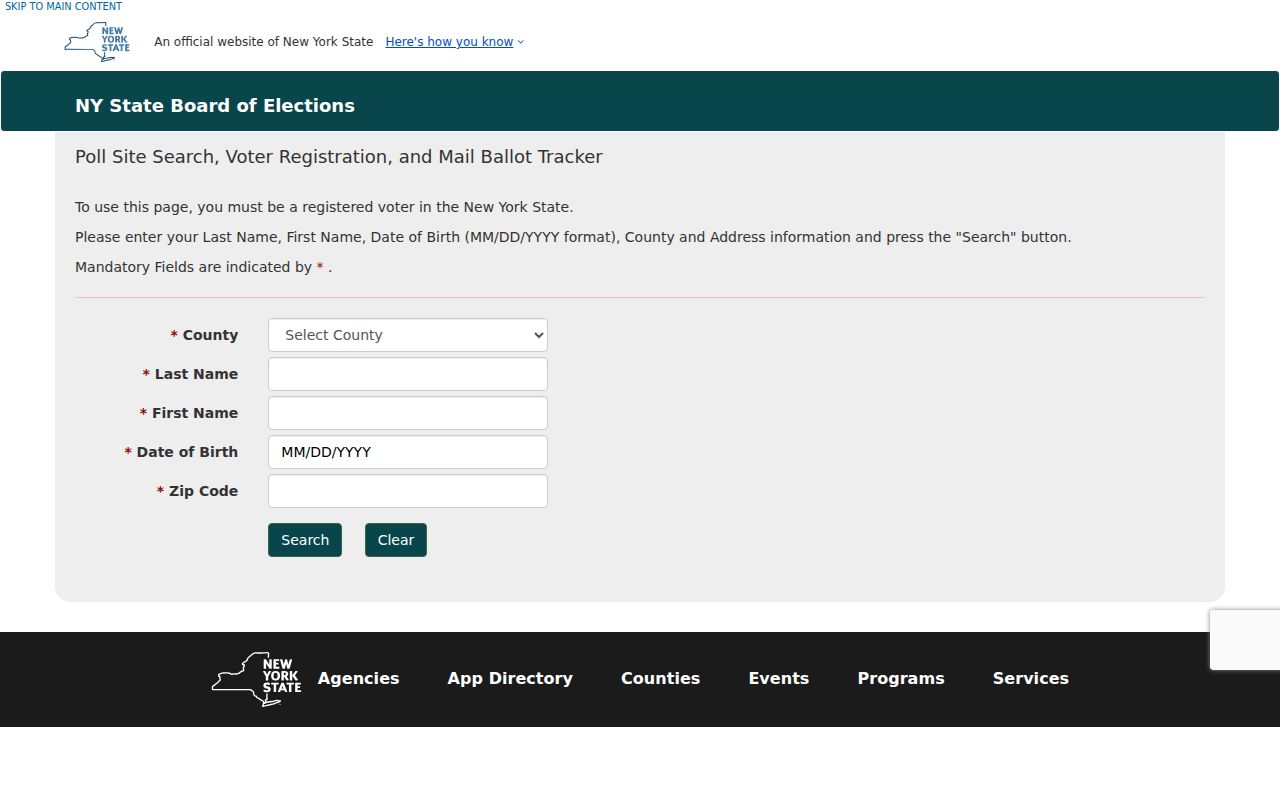
County, name, date of birth, and ZIP work together. A lone surname is never a sound Town of Newburgh match.
Town of Newburgh Court Routes
A court index confirms that a matter was filed. It proves nothing about where someone lives now. New York keeps several public court systems, and each covers a different docket. Civil matters in local courts appear in WebCivil Local. Estate research runs through WebSurrogate. Supreme Court and criminal matters sit in separate systems. WebCivil Local returns an index number, party names, attorney, judge, court, case type, filing year, status, and scheduled appearances. Output comes in HTML or PDF. Sealed and otherwise protected matters never appear in these indexes.
Town Court records take a different path. The Town FOIL page excludes court documents entirely. For a Town Court file, contact the court directly at 311 Route 32, 845-564-7161. Probate or heir work can start in WebSurrogate. It can then move to Orange County Surrogate's Court or the OCGS probate index covering 1787–1941. When the same name shows up twice, compare party role, court, case number, and date. Then choose between them.
Current Town of Newburgh Directories
Every Town of Newburgh resident source stands alone as a record system. The parcel route names an owner of record and ties land to a person. Voter rolls answer only a narrow registration question. Deeds identify who conveyed what, and when. Court, business, and license indexes can offer leads. None of them, by itself, proves a residence. Those distinctions matter when you are weighing a family-history lead, an estate matter, an unfamiliar seller, or a possible scam.
| Source | Evidence | Keeper | Access |
|---|---|---|---|
| Parcel and assessment | Owner, parcel, tax-map, values, and described maps/photos | Orange County Real Property | Free county route advertised |
| Voter status | Limited status for identified inputs | New York elections | Protected records and file restrictions apply |
| Recorded land records | Grantor, grantee, and legal-description trail | Orange County Clerk | SearchIQS account or record-room route |
| Town records | Existing non-exempt municipal materials | Town Clerk | FOIL form or written request |
| Local history | Old names, addresses, papers, maps, and yearbooks | Newburgh Free Library | Catalog and in-person holdings |
Official records always have a named custodian. They also have a way to correct them. Commercial people-finder sites often merge stale data or blend same-name individuals. Treat those compilations as an unverified lead. Then return to the office that holds the actual record.
Verify a Town of Newburgh Match
Same-name errors trip up searches all the time. Build a Town of Newburgh match on at least two stable details: full name plus municipality, approximate age, parcel address, middle initial, a known relative, or a public business affiliation. Try spelling variants, initials, married and widow names, route numbers, and common street abbreviations. Keep the spelling exactly as the original record shows it. Note the normalized form you searched. One court hit or one old directory line is a lead, not a conclusion.
- Parcel
- A mapped unit of land tied to an assessment or tax-map identity.
- Situs address
- The physical location of a building or parcel.
- Mailing address
- The location used for tax correspondence, which can be elsewhere.
- Index
- A finding aid that points to records and may not include an image.
- Criss-cross directory
- An address-to-name arrangement used in later local directory years.
Pair one current source with one independent source. A parcel owner plus a recently recorded deed supports an ownership conclusion. A dated directory line supports a historical one. So does a census, obituary, newspaper, or probate record. Found an error? Report it to the assessor, clerk, court, or elections office. You can also report it to the state agency that controls the record.
Town of Newburgh Archive Shelf
The Newburgh Free Library Local History Collection holds city directories back to the 1860s. It also keeps telephone books from the 1930s into the early 2000s, plus maps, photographs, yearbooks, clippings, local histories, and genealogy guides. Search the catalog by surname, street, church, school, cemetery, neighborhood, or organization. Some databases carry in-library conditions. Confirm access with the library before counting on remote use.
Other shelves fill different gaps. The Historical Society asks for written, specific questions. The OCGS research room in Goshen keeps incomplete Newburgh directories for 1899–1956. It also holds deed, mortgage, probate, census, map, and newspaper records. The New York State Library, County Clerk record room, and New York Heritage each add pieces. These alternate routes matter. The public SearchIQS landing page does not state its online land-index cutoff year.
Historical Town of Newburgh Directories
Historical research goes better with a simple source log. For each find, record the directory title and year. Note the spelling used and the address exactly as printed. Add the municipality in use at the time and the shelf or database where you saw it. Add the date of any nearby deed, census, map, newspaper notice, or assessment image. Do this instead of folding everything into one undated story. That discipline shows whether a Town of Newburgh household is truly identified. It can also show whether a city, regional, or similarly named record still needs a boundary check.
Old Newburgh directories are regional sources, not automatic proof of Town jurisdiction. The New York State Library lists discontinuous runs starting in 1856/57. These run on fiche or film through 1948. Newburgh Free Library, the Historical Society, and OCGS hold related material. Before 1918, the Society notes, directories are surname-alphabetical with no address cross-index. From 1918 on, both address and surname searching work. Entries can carry a name, address, occupation, marital-status notation, and legal-age household clues. Publisher names and exact abbreviations still need checking.
Pair each directory year with parcel, deed, map, or census work. Federal schedules are public through 1950. State census survival varies after the 1911 State Capitol fire destroyed many records. The fuller collection is laid out in the Town of Newburgh directory book. The reading method appears there too.
Town of Newburgh FOIL Requests
The Town FOIL request route covers existing non-exempt town records. The governing law is Public Officers Law Article 6, §§84–90. The Town commits to acknowledging a request within five business days and, where responsive records exist, answering fully within 21 business days. Listed copy charges run $0.25 per page and $5 for maps. Appeals go through the Town Clerk.
FOIL cannot sweep aside vital-record, voter, DMV, court, library, or Address Confidentiality Program protections. Name the record, the date range, and the format you want. Court files belong with the court, not this route. If a record is withheld, ask the custodian which exemption applies.
The Town's FOIL page displays its form-center route and response timing.
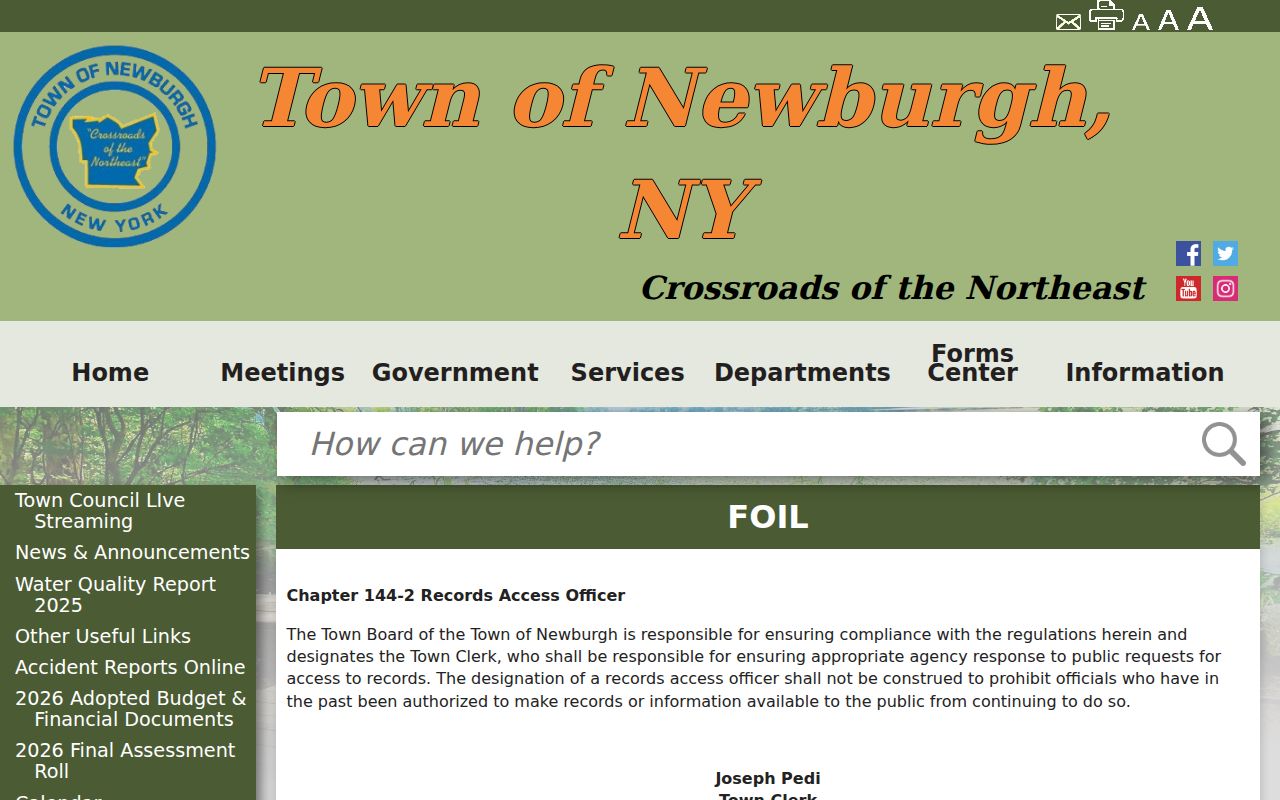
A FOIL request works best when a record already exists. The Town cannot be asked to build a new personal directory from scratch, so name the specific document you want and the office that holds it.
Town of Newburgh Registrar Records
The Town Clerk and Registrar files every birth and death that happens in Town of Newburgh. The office also issues town marriage licenses. St. Luke's Hospital births follow a different route. Those events belong to the City of Newburgh Registrar. A Newburgh mailing address does not change that. The Town Clerk and Registrar service page spells out local copy rules, photo-ID and mail-request requirements, and the $10 charge for eligible local copies.
A genealogy copy through the New York State Department of Health is not an unrestricted public index or certified copy. New York genealogy rules use 75 years for births. Death and marriage records drop to 50 years. Known-deceased and relationship rules still apply. Match the event location, your relationship, and the copy type to the right custodian before sending a request.
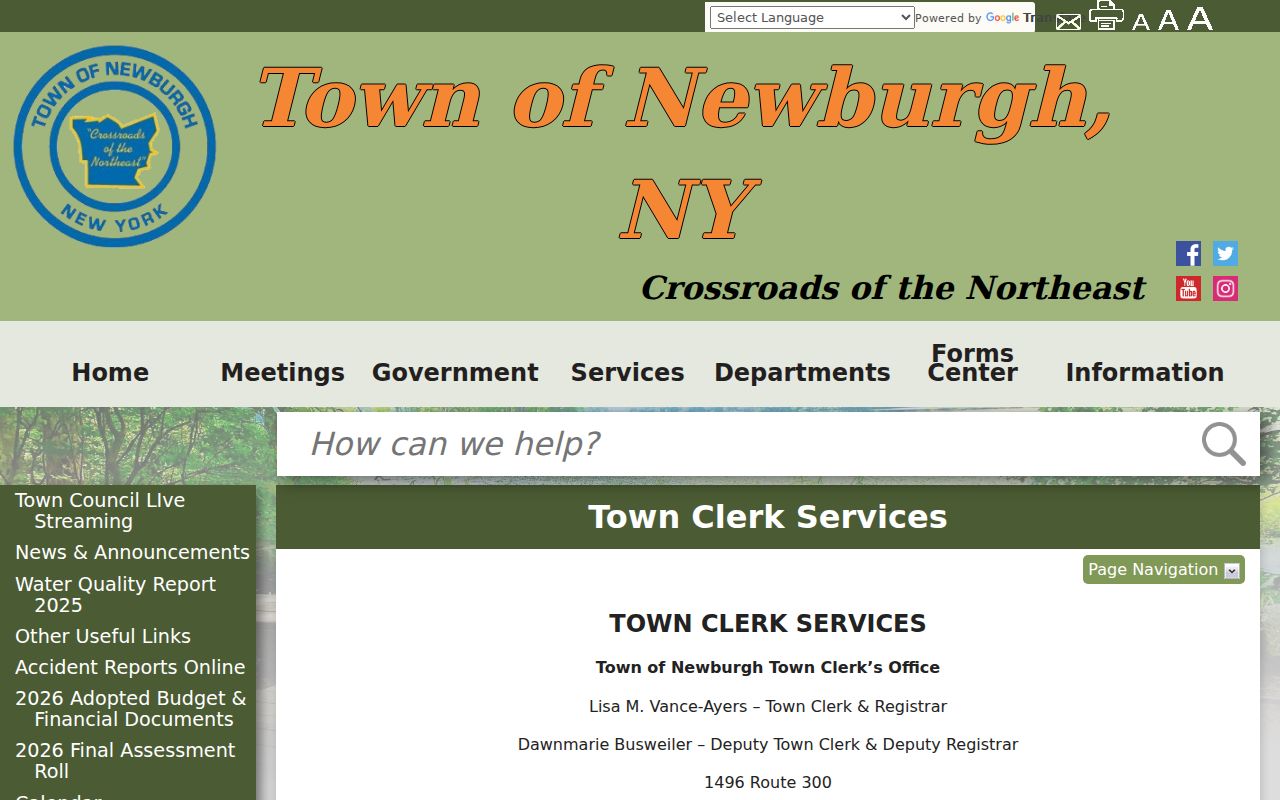
Confirm the event jurisdiction before requesting any Newburgh area record copy. Checking where the event was filed first prevents a common mix-up for eligible requesters.
Town of Newburgh Status Tools
Not every official lookup works like a residents directory. Some state tools answer a narrow custody question instead. New York DOCCS asks for a full name plus a date of birth or a DIN before it reports state-custody status. The federal locator searches by name or number. Its federal records reach back to 1982. New York's public registry sets its own eligibility, result, and use limits. None of these sources confirms a current address, and an empty result in one database says nothing about another system. The Federal Bureau of Prisons inmate locator page shows both the name and number routes for federal records.
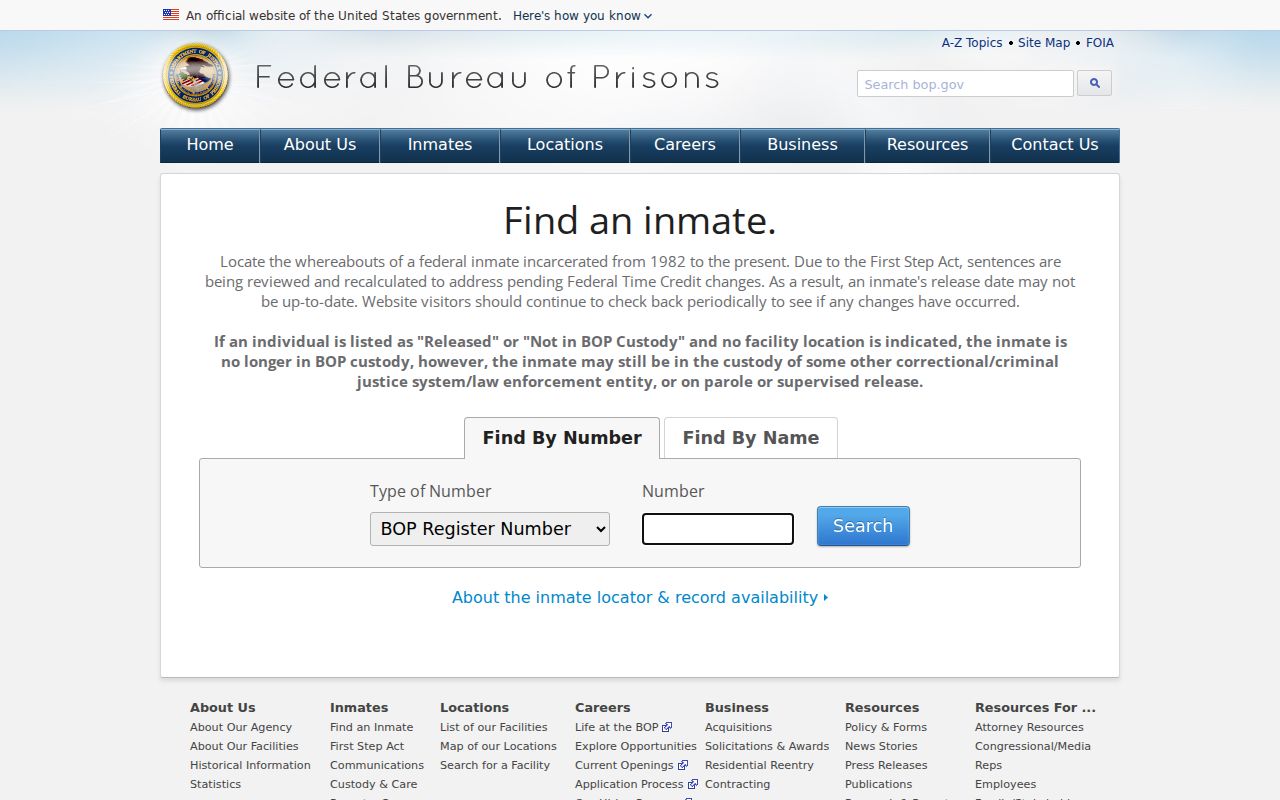
Rely on live official results only. Pair any result with corroborating identity details, and never read it as a full account of a person.