
Town of Newburgh City Directory Collections
Town of Newburgh researchers have several shelves to compare, rather than one complete run. The New York State Library lists Newburgh directories in fiche and microfilm, Newburgh Free Library reports city directories back to the 1860s, and the Orange County Genealogical Society holds an incomplete Newburgh-area run. The Historical Society adds a research archive and describes later address access. Each collection has gaps. Treat the date range beside a volume as coverage for that volume, not as proof that every household or every part of Town of Newburgh appeared in print.
| Collection | Years | Where held | Access |
|---|---|---|---|
| NYSL fiche directories | 1856/57; 1858-59; 1860/61 | New York State Library genealogy collection | Fiche consultation |
| NYSL film directories | 1864/65; 1872/73; 1874/75; 1879-84; 1887; 1889; 1898-99; 1901-31; 1937-42/43; 1946-48 | NYSL list; related local collections | Microfilm route |
| Newburgh Free Library local history | Back to the 1860s, exact shelf run unstated | Local History Collection | Catalog and in-person research |
| OCGS Newburgh directories | 1899-1956, incomplete | 1841 Historic Courthouse, Goshen | Research-room collection |
| Telephone directories | 1930s to early 2000s | Newburgh Free Library | Later household-era clue |
The research does not verify a named publisher for these Newburgh runs. It also does not establish a final printed year or a complete criss-cross run. Those gaps matter because a missing volume is not a blank period in a family's life.
Town of Newburgh City Directory Years
The New York State Library directory list is the most precise starting point for the surviving historic runs. Its list begins with the 1856/57 fiche and continues, with breaks, through 1948 on film. A careful Town of Newburgh search records the exact issue used and notices every missing interval. The municipal history adds another caution: the Village of Newburgh separated in 1800 and the City of Newburgh incorporated in 1865. A nineteenth-century Newburgh entry may describe the city, the surrounding service area, or a place whose later jurisdiction needs separate proof.
The State Library's city-directory listing shows the format and discontinuous years available for Newburgh.
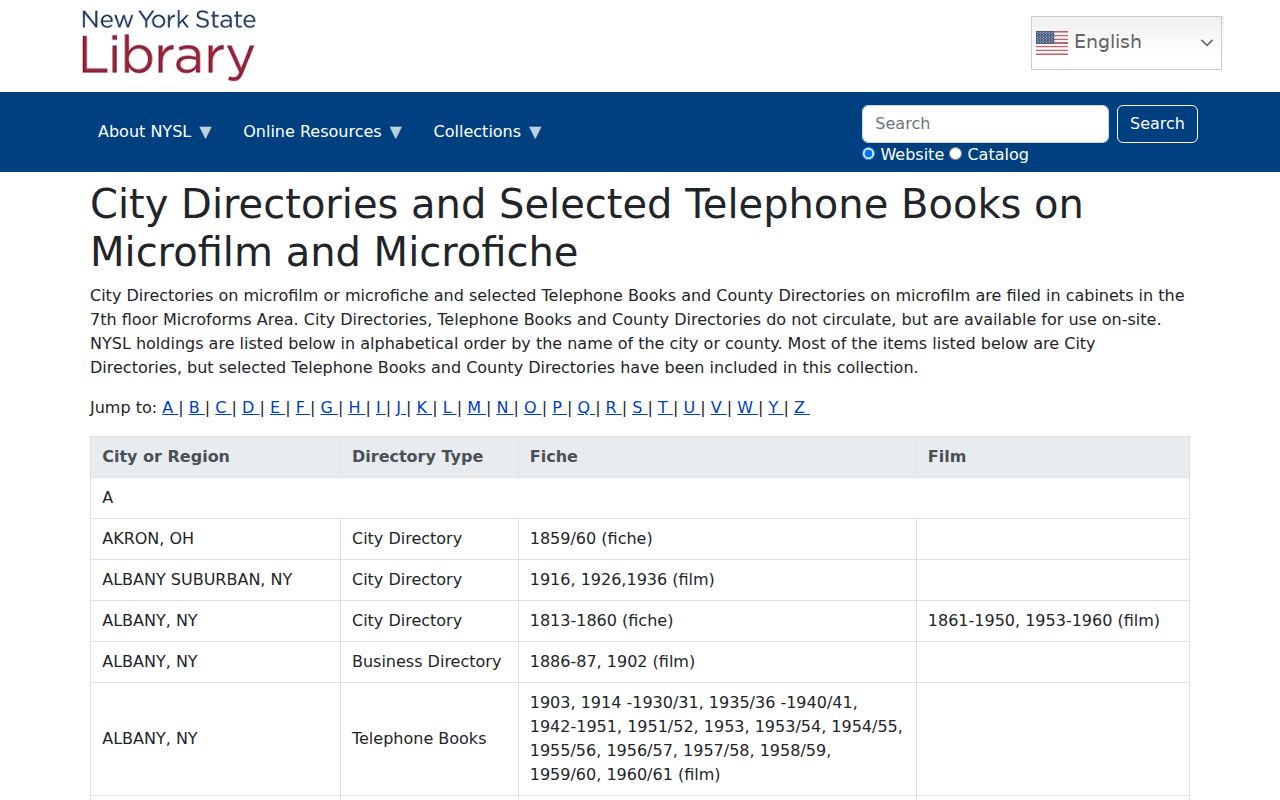
Use the list to choose a year close to a census, deed, or family event, then note which years are absent before drawing a conclusion from a gap.
| 1856/57 to 1860/61 | Earliest listed Newburgh fiche years in the State Library collection. |
|---|---|
| 1864/65 to 1898/99 | Film years appear in short and longer clusters, with several missing intervals. |
| 1901 to 1931 | A continuous listed film span, followed by later gaps. |
| 1937 to 1948 | Later listed runs include 1937-42/43 and 1946-48. |
Town of Newburgh Directory Shelf
The Newburgh Free Library Local History Collection is the practical local shelf for Town of Newburgh directory work. It reports roughly 4,000 books, city directories from the 1860s, telephone books from the 1930s into the early 2000s, maps, photographs, yearbooks, local church material, family histories, clippings, and selected cemetery records. Its catalog has about 75,000 items. Search a surname, street, school, church, cemetery, organization, or neighborhood term, then ask staff whether an item is city-focused, town-focused, or regional.
The library also offers database routes that can supply a census or newspaper companion. Ancestry Library Edition is for in-library use, while the library names HeritageQuest, Newspapers.com Library Edition, FultonHistory, and related resources. A newspaper OCR hit needs a page image and date check. Telephone books are later clues, not a complete Town of Newburgh resident list.
Note: Confirm current library hours and database access conditions before a Town of Newburgh research visit.
Town of Newburgh Archive Requests
The Helen Gearn Memorial Library of the Historical Society of Newburgh Bay & Highlands is another Town of Newburgh research stop. Its archive is on the second floor of Crawford House at 189 Montgomery Street, and appointments are offered Tuesday through Thursday from 2 to 6. The Society asks researchers to submit written, specific questions. A request that states a surname variant, street or place, date range, likely municipality, and desired record type gives the archivist a usable starting point.
The Historical Society archive page describes its catalog and appointment-based holdings.
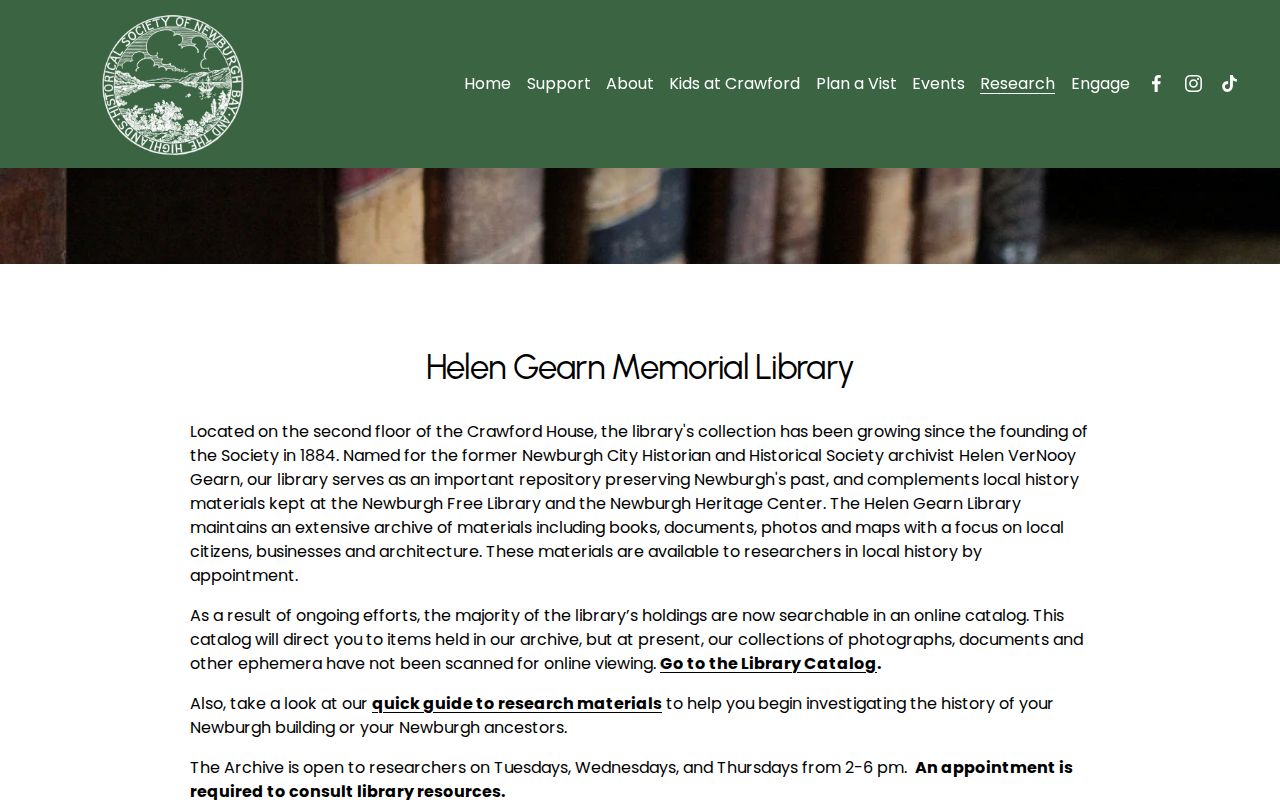
PastPerfect can identify material, but many photographs, documents, and ephemera are not scanned, so a catalog result may lead to an appointment rather than an online image.
OCGS supplies a complementary Goshen route. Its research room holds a master surname index, local maps, census material, deed and mortgage indexes, probate tools, newspapers, and incomplete 1899-1956 Newburgh directories. The collection is especially useful when a Town of Newburgh directory question needs to be tested against county evidence.
Read Town of Newburgh City Directory Entries
A Town of Newburgh city directory entry should be transcribed exactly before it is interpreted. The Historical Society supports a limited inventory: surname or name, address, occupation, marital status, and legal-age household residents may appear. That is valuable for family history, yet it does not turn an entry into a current address confirmation or a municipal-boundary decision. Compare the spelling against a census, parcel, deed, map, newspaper, or church record that fits the same date and locality.
| Name | Record the full visible name, initials, and spelling exactly as printed. |
|---|---|
| Address | Preserve the number and street, then compare it with a period map or land record. |
| Occupation | A possible work or organization clue, not a substitute for a residence record. |
| Marital status | Copy only the notation actually visible in the volume. |
| Legal-age household residents | List each person shown and retain the directory year beside the transcription. |
- Criss-cross directory
- A later address-led arrangement that can connect a street address with an occupant clue. The Society describes address and surname searching from 1918 onward.
- Householder index
- When a volume provides one, it is a name-led aid for the person or household named in the directory. The local research did not verify one for every Newburgh volume.
- Abbreviation key
- A key normally printed by a publisher to explain marks or shortened terms. No Newburgh key was verified in the inspected sources, so inspect the volume rather than guessing.
Do not add owner marks, spouse conventions, widow abbreviations, employer details, or publisher claims that are not visible on the page. The source review did not verify those features for the Newburgh directories.
Town of Newburgh City Directory Divide
The most useful local directory rule is chronological. Before 1918, the Historical Society says Newburgh directories are alphabetical by surname and have no address cross-index. Start with a known surname, initials, or variant spelling for those years. From 1918 forward, the Society describes both address and surname search routes. That later arrangement can support a street-first check, but only after the Town of Newburgh address has been tied to a parcel, deed, or map.
This shift changes the order of work. A pre-1918 house question often begins with the deed chain, census, or a family name. A later Town of Newburgh directory search can begin with an address, then move back through the surname entries. Neither method proves that every resident was listed.
Town of Newburgh City Directory Geography
Directory geography is the central Town of Newburgh caution. The City and Town are separate municipalities, and 12550 is shared by both. A directory line that says Newburgh does not settle the question. The property may be in the City, the Town, New Windsor, Marlboro, or another nearby locality depending on its date and source. Write down the county, municipality, postal label, and source type for every finding. That small record trail makes later corrections much easier.
The Town's 1763 precinct history, its 1788 organization, the 1800 village separation, and the 1865 city incorporation explain why old Newburgh labels need a date. For modern address-keyed research, use the Town of Newburgh street directory route after the historical evidence has been placed in the right municipality.
Town of Newburgh City Directory Family Tracing
Use Town of Newburgh city directories as dated snapshots of a household. Begin with the closest available issue to a known census, death notice, deed, or family letter. Copy the entry and its surrounding clues, then seek the next available issue rather than assuming every year survives. Federal census schedules are public through 1950, and the Historical Society identifies New York state census years from 1825 through 1875, then 1892, 1905, 1915, and 1925 where records survive.
- Record the surname, variant spellings, address, occupation, marital-status notation, and each legal-age household resident shown in the selected directory.
- Check the closest earlier and later directory issues, using surname order before 1918 and the address route only where the later volume supports it.
- Pair each Town of Newburgh directory observation with the nearest federal or surviving state census, keeping the census geography visible.
- Compare a move or disappearance with a deed, probate lead, cemetery record, church record, newspaper notice, or telephone directory.
- Keep a separate note for City, Town, regional, and postal labels so that a family is not assigned to Town of Newburgh by a broad Newburgh reference alone.
A disappearance can mean a move, death, changed spelling, incomplete coverage, or a directory that did not include the household. It does not prove that a property was vacant or that a person left the area. The 1911 State Capitol fire also destroyed many New York state-census records, so a missing state-census line may require a county copy, newspaper, cemetery, church, or federal-census substitute.
Map a Town of Newburgh Directory Address
The 1913 Newburgh Sanborn collection has 69 sheets and can help place a directory address among streets, building footprints, construction notes, water mains, and nearby structures. It covers a congested district, not automatically every rural Town of Newburgh parcel. Check the sheet index and extent before using it as location proof. For a property outside its coverage, a tax map, deed description, historic atlas, or county GIS record may be the better bridge.
Newburgh Heritage adds 1916 assessment photographs and municipal material that can give a place context. A photograph can date a building appearance, but it does not name every occupant. Pair it with the exact address, parcel, deed, or tax-map evidence before adding it to a Town of Newburgh family trail.
Town of Newburgh Directory Research Gaps
Several useful sources are incomplete by design. The OCGS directory run is incomplete, the library does not state every shelf year online, and the State Library listing leaves gaps between issues. The Historical Society asks for specific written questions because much of its archive is not digitized. When online cataloging stops, move to the library, the Society, OCGS, or the Orange County Clerk record room instead of filling a gap with an assumption.
Newburgh Municipal Records at NY Heritage span 1782-1915 and are browsable by subject. Their 2025 library archive feature on Almshouse reports and transcriptions is a reminder that institutional records may preserve a name even when a standard directory does not. Source absence is therefore a reason to try another repository, not proof of absence from Town of Newburgh history.
Note: Keep the volume date, repository, municipality, and page or image reference with every Town of Newburgh directory transcription.